In the past month, China has achieved significant progress in its quest for the holy grail of clean energy solutions, i.e., controlled nuclear fusion. The traditional nuclear fission technology involves the splitting of atoms to create energy, a process that generates nuclear waste that is not only detrimental to the environment but is also very long-lived. On the other hand, nuclear fusion technology “fuses” atoms to generate energy without harmful nuclear waste. It is the same process that powers the billions of stars in the universe, including our sun in the solar system. Hence, the moniker “artificial sun” is often applied to nuclear fusion technology.
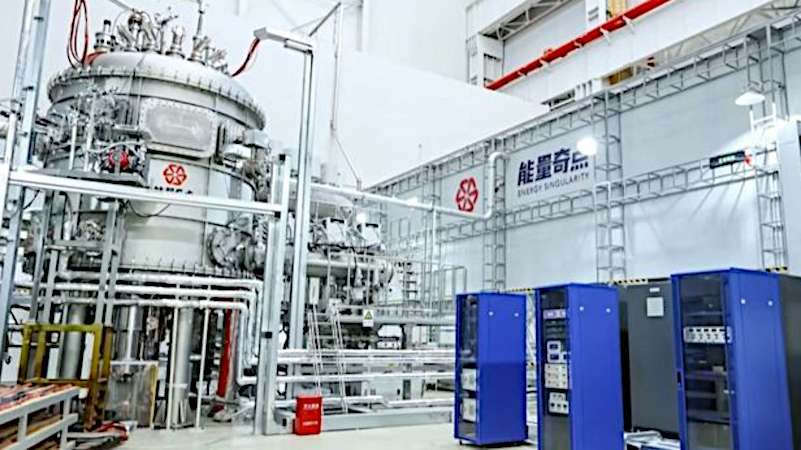
In order to achieve fusion, the hydrogen isotopes have to be heated to an extremely high temperature and pressure, exceeding 100 million degrees Celsius, and have to be confined for a sufficient period of time for successful fusion into heavier elements such as helium. In the process, a tremendous amount of energy is released. For the continuous generation of energy, the principle of magnetic confinement is used. In magnetic confinement, strong magnetic fields are used to create a container that confines the charged particles in the plasma. The device of choice for magnetic confinement of the hot plasma gas in nuclear fusion is the Tokamak.
Nuclear fusion is widely regarded as the Holy Grail of clean energy solutions for a variety of reasons. First, fusion reactions are fueled by hydrogen isotopes, a readily available resource that is abundant in sea water. Unlike fossil fuel technology, which emits harmful greenhouse gases, and nuclear fission technology, which produces long-lived radioactive waste, nuclear fusion emits none of these byproducts that are harmful to the environment and threaten life on earth. Additionally, fusion reactions are inherently safe, i.e., there is no risk of runaway reactions or meltdowns that plague nuclear fission reactors. Overall, nuclear fusion technology is regarded as the holy grail of clean energy solutions because it can provide abundant, clean, safe, and sustainable energy to the world.
CGTN recently reported that China has achieved a groundbreaking milestone in fusion technology with the completion and operation of the world’s first fully high-temperature superconducting tokamak device, named HH70, in Shanghai. The HH70, designed and built by Energy Singularity, is smaller and cheaper, and construction took just two years to complete. The HH70 features a magnetic system made from high-temperature superconducting materials. The HTS tapes used in the HH70’s magnetic system are supplied by Shanghai Superconductor, a major global supplier. In the process, Energy Singularity managed to set a world record for the rapid development and construction of a superconducting tokamak device. This successful development represents a major step forward in verifying the engineering feasibility of high-temperature superconducting tokamaks, paving the way for a clean and sustainable energy future.
In a separate article, Global Times reported that China has achieved a significant breakthrough in controlled nuclear fusion with the Huanliu-3 (HL-3) tokamak, also known as China’s next-generation “artificial sun.” For the first time ever, researchers have discovered an advanced magnetic field structure that enhances the control and operational capabilities of nuclear fusion devices. The HL-3 tokamak, designed and developed independently by China, is a large-scale scientific facility for controlled nuclear fusion. This new development positions China at the forefront of the world in this field.
China’s recent advancements in HTS materials and fusion technology, along with its robust industrial chain and engineering expertise, position it as a key player in the emerging fusion market. The nation’s strategic investments, industrial capabilities, and talent pool in fusion technology are setting the stage for potential leadership in the global fusion industry.